RMR (resting metabolic rate) is the calories your body burns at complete rest. At Hexis we measure it directly, from the air you breathe.
Video: what RMR is, and why measure it. About 2 and a half minutes.
The same points as the video, with the studies they come from.
RMR means resting metabolic rate: the energy your body uses at rest, just to keep you running. It is the biggest part of the calories you burn in a day. So if that number is wrong, the whole plan is wrong.1
Most eating plans start from a guess: an app, a food label, a formula. Even the best formulas can miss. In one study, the best formula was off by more than 10% for about 1 person in 5.2
In our sample report, the formula said 1,624 calories a day. The measurement said 1,490. That is a gap of 134 calories every day.
Your own gap may be smaller, larger, or in the other direction. An RMR test measures your own number.
This is an example, not a typical result.
Your RMR, plus your daily life, plus your exercise, gives your real daily number: the calories you burn in a day. Not an average person's. Yours.3
To hold your weight, eat about the calories you burn. To lose, a little less. To gain, a little more. Your RMR shows you where to aim.
Cut too little, and you do not see results. Cut too much, and it works against you.4
When you lose weight, by any method, including medical treatment, some of it can be muscle. Less muscle means a lower RMR. Strength training and enough protein help protect your muscle, and your RMR with it.5
It moves as your weight, your muscle and your habits change. A retest shows where your RMR is now, so you adjust your eating and your training to your body today, not to an old guess.
The calorie figures on this page are example numbers. The studies show links, not guarantees, and measuring your RMR does not by itself promise a result.
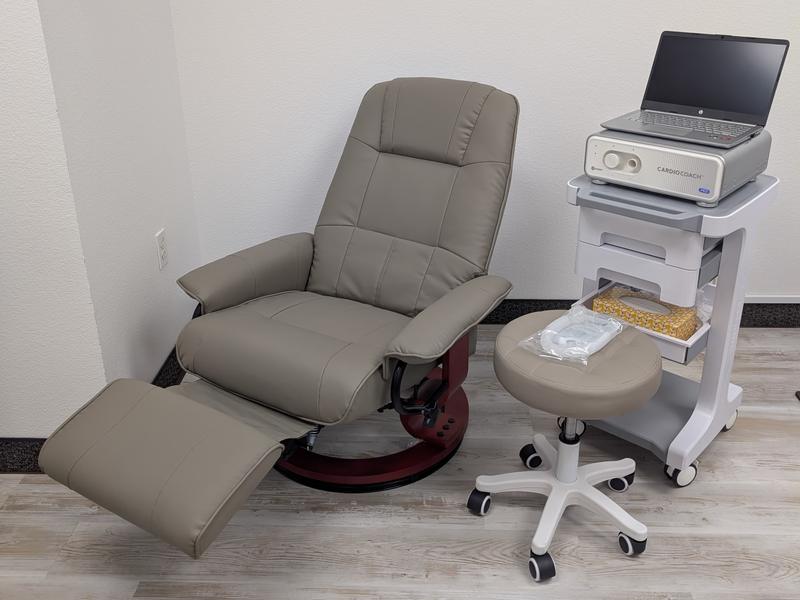
One client at a time, in a quiet private room. Nothing hurts, and nothing is tiring.
You follow a few simple rules about food, caffeine and exercise before you come. We check how you feel, your blood pressure, pulse and oxygen level.
You rest in a recliner for about 10 minutes, with soft music playing low and a comfortable temperature.
You breathe normally through a new mouthpiece, used only by you, with a soft clip on your nose.
You stay still, stay awake and breathe normally. The analyzer looks for five calm, steady minutes. Then we go through your numbers with you.
Food, coffee and exercise all speed your body up for hours, so a few rules apply before you come. See how to prepare, with a short video of the test

After the test we sit down with you and explain your numbers in plain words. You also take home a written report.
By appointment only. You pay at the studio on the day of your test.
(resting metabolic rate: the calories your body burns at complete rest)
Allow 1 hour 15 minutes
Early-morning, evening and weekend appointments are available. After-hours appointments cost $20 extra per test, and you see the price before you book.
This test is a wellness and fitness measurement, not a medical diagnosis.
Your RMR shows how much energy your body uses. A second test shows how fit you are and how hard to train.
A VO2 max test measures your fitness at full effort and gives you your personal heart-rate training zones.
See the VO2 max test →Train by your zones. Eat by your number. VO2 max and RMR together give you the two numbers a plan is built on.
Book both →No. You rest in a recliner and breathe normally. Nothing hurts, and nothing is tiring.
The measuring usually takes 10 to 20 minutes. Allow 1 hour 15 minutes for the whole visit.
There are a few simple rules about food, caffeine and exercise before your visit. Water is fine at any time. See the preparation page and video.
An app uses a formula. In one study, even the best formula was off by more than 10% for about 1 person in 5. The test measures your own number, from the air you breathe.2
It shows where your measured number sits compared with the formula estimate for someone of your height, weight, age and sex.
No. These are wellness and fitness measurements, not a medical diagnosis.
Video music: "Dreamer" by Kevin MacLeod (incompetech.com), Creative Commons Attribution 4.0.
One quiet visit. Your own number. A clear place to start.